Digital Repeater Controller
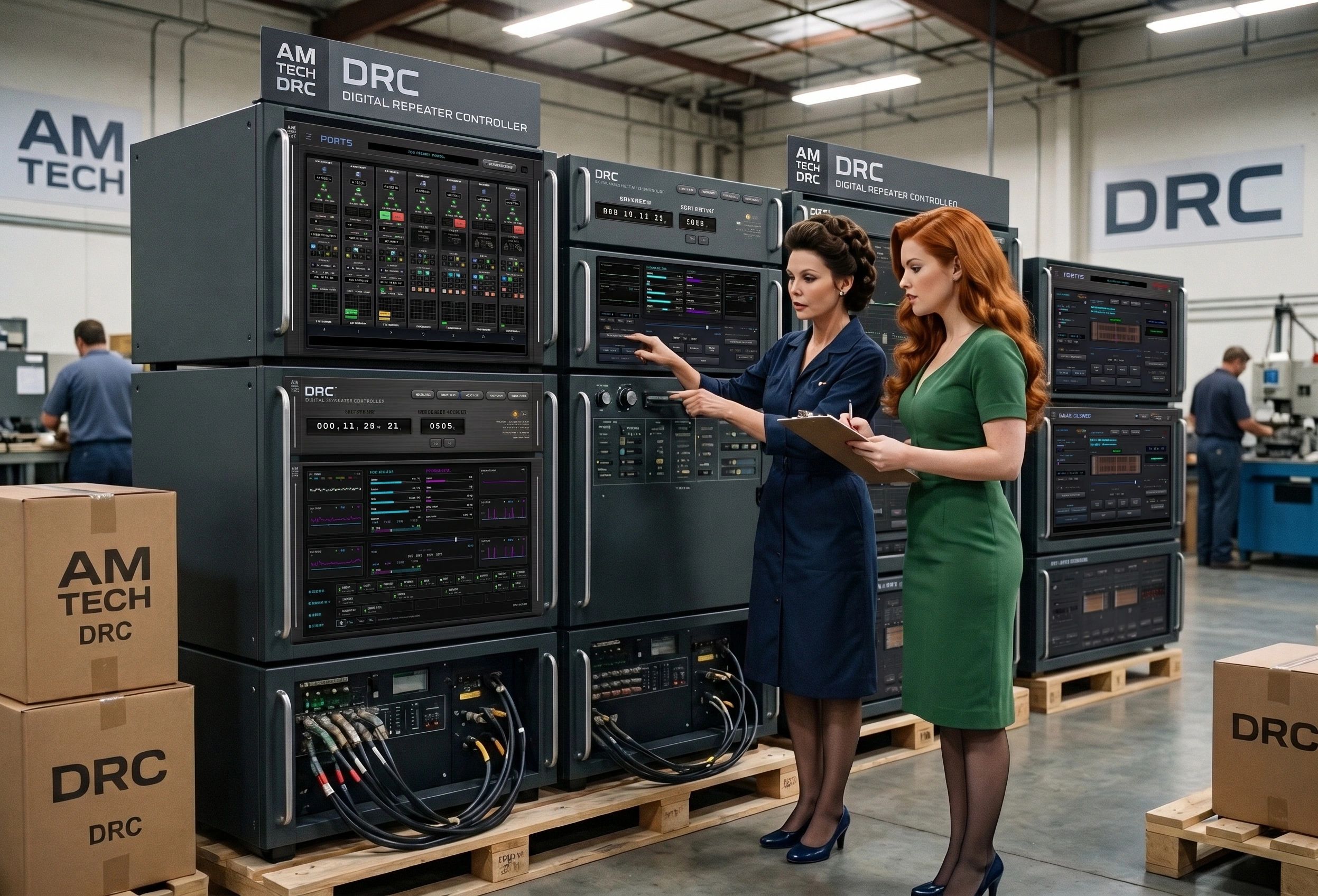
This page will provide information about DRC, which is a software / hardware solution implemented on 3 of the SPARC repeaters.
Some 505 History
by Brian, K1SOX
You may be wondering how the repeater makes its sound effects and voice IDs. The original repeater controller was an ACC RC-850. It could speak “canned” words in a male voice called “Romeo,” plus a few female words from “Juliet.” An ACC newsletter mentioned that you could write a batch file on a PC and tie it into the controller to play wav files.
I mentioned this to Meyer (AA1NQ), and he had the idea of writing a program in Turbo Pascal that could do this and much more. Sometime in 1994 we started on a program we called “DVP,” the Digital Voice Program. Meyer did the coding, and I came up with the integration ideas and did the testing. It needed a genuine Sound Blaster 16 card in an ISA slot and, of course, ran on DOS. We added rotating and random IDs and courtesy tones, voice mail for repeater users, an echo test and more. Danette (N1QAF) and I created most of the IDs and courtesy tones, and many of them are still on the repeater today. Later on, I renamed the program DRX, the Digital Repeater Xpander.
Willie (N1NKM) built a better interface cable between the controller and the PC. He also solved a problem where the remote base controller kept getting damaged because it shared a data pin with DRX; a Zener diode now protects the RBI. He also designed a remote reset box for emergency controller resets.
In October 2012 the repeater moved from West Haven to Woodbridge, and it ran in a “basic” mode until 2021.
I then rebuilt the repeater around an SCOM 7K controller with a Vyex DAB (Digital Audio Board), replacing DRX with a more manageable, modern setup. I wrote macros on the 7K to play timed random and rotating wav files, which it couldn’t do natively. Other features, such as the echo test, minutes of repeater activity and weather conditions, moved to the Raspberry Pi that is also our EchoIRLP node. I wrote those scripts in Bash. I assembled and tested the new system at my house, and on 5/22/2021 Dan (KB1MMR) helped me take it to Woodbridge.
In the spring of 2025, Rick (W1RJC) pointed out that the 7K’s successor, the 7330, could receive serial data and use it in messages. He thought DRX could be brought back to work with it. That summer I wrote an entirely new DRX (version 2) in Python for the Raspberry Pi. It ran alongside the 7330 and could be controlled from a web page.
DRX 2 showed what the software could do, but it still depended on another controller. So I took the next step: DRC, the Digital Repeater Controller. DRC is the controller itself. It runs on a Raspberry Pi 5 with USB sound cards, and on November 7, 2026 it went on the air running three of the club’s four repeaters, 147.505, 224.040 and 442.500, plus their AllStarLink nodes. (Our 224.500 repeater is at a remote site and still runs its SCOM 7K controller.) DRC handles up to 16 ports, so the repeaters can be linked directly to each other and to the internet. Because we wrote it ourselves, it can grow whenever the club needs something new.
A Note from Nicole
Good day, and welcome to the DRC webpage. I’m Nicole, the voice of DRC. You’ll hear me on the 147.505 repeater’s IDs, announcements and courtesy messages, and I read the weather on all three DRC repeaters.
I have company now. DRC gives each repeater its own personality. Romeo and Juliet, the classic repeater voices, are back on 224.040. Ava is the new voice of 442.500.
DRC isn’t an add-on to someone else’s controller any more. It is the controller. That means 147.505, 224.040 and 442.500 share the same features, the links between them are direct, and Brian can keep adding new things for the club.
DRX User Features
Three repeaters, one controller. Signal reports, the echo test, weather, Newsline and the other user features that used to be only on 147.505 now work on 224.040 and 442.500 too.
Direct linking. The repeaters link to each other directly, so the SPARC Net no longer goes through IRLP. There’s far less delay and the audio is much cleaner.
AllStarLink. 224.040 and 442.500 now each have their own AllStarLink node.
SID: Speaker Identification (147.505). An AI system that recognizes a user’s voice and shows their callsign on the public page. It keeps learning and corrects itself during the transmission.
Custom Courtesy Tones (147.505). Through SID, a user can have a courtesy tone of their choosing. It can be permanent, or play for a set period with a cooldown, and it can also play when they come in through AllStarLink.
Custom Initial ID per user (147.505). If the repeater has been quiet and SID hears enough of your voice (4-5 seconds), Nicole greets you by callsign instead of giving the usual ID, followed by your signal strength and percent quieting into the repeater. The repeater owner can customize these further.
S-Meter and Percent Quieting. DRC reads each receiver’s signal strength and quieting. Ask with a user code and the repeater speaks your S-unit and quieting back to you.
Deviation Test. A user code to check your radio’s modulation.
DTMF Test. A user code to test your keypad; the digits are read back to you.
Echo Test. Hear exactly how your audio sounds through the repeater.
CTC: Courtesy Tone Change. One code moves the courtesy tone on early. It has a cooldown so it can’t be triggered over and over.
Weather Conditions. A fast, natural-sounding report. It won’t step on your QSO: if the repeater is busy when the full report is due, you just hear the temperature. There’s also a user code to hear it on demand.
Weather Alerts. DRC watches National Weather Service alerts for New Haven County and speaks the important details on the air. A short tail message tells you an alert is in effect, and an alert brief plays before the weather conditions. When there are several alerts it keeps to the major ones. If the repeater is busy, a warning plays first so users can stand by. There’s a user code to replay the alert.
Newsline. Amateur Radio Newsline and ARRL Audio News are played on the air, with the club’s station ID in place of the network’s cue tones.
Live Streaming. Listen from a browser in high quality with low delay (RTK), or use the MP3 stream on weaker cell service. On the public page or the compact pop-out streamer (vintage 1980s cassette-deck styling), you can pick which repeaters you hear in your left and right ear, and put more than one in an ear to mix them.
Public Web Page. Live S-meter, SID callsign display, Now Playing, AllStarLink / EchoIRLP status, weather, and a look at ID, message and courtesy-tone rotation.
More to come...